
An Architecture for Sensemaking
What we’re learning about organizational change in New York schools
Melissa Emler · Chief Learning Officer, Modern Learners · August 2026
1Leading While the Rules Are Changing
The New York context and the challenge of leading while answers are still emerging
If you are reading this, there is a good chance the New York State Education Department (NYSED) is asking your district to think differently about student success.
Perhaps your community is making sense of the New York State Portrait of a Graduate. Perhaps your teachers are exploring inquiry-based learning, project-based learning, or performance-based learning and assessment. Perhaps your board is asking what a competency-based diploma will mean for students who are in school today.
Most likely, you are trying to make sense of all of it at once.
I know that feeling because our team at Modern Learners has spent years learning alongside school leaders navigating significant changes in teaching, learning, and assessment. Most immediately, that learning comes from our work in New York. Through the Performance-Based Learning and Assessment Networks (PLAN) Pilot, we worked alongside 17 districts exploring Portrait of a Graduate and Performance-Based Learning and Assessment. Another 20 districts are continuing related work through Inspired by Design (IBD), a Modern Learners initiative that builds on the learning and practices developed through the PLAN Pilot. Those experiences build on years of work with school systems in Wisconsin and other states wrestling with many of the same questions in different contexts.
This paper grew from that work.
It is not a formal evaluation of the PLAN Pilot or the districts participating in it. Those findings belong to NYSED and its research partners. What I am sharing here are field informed observations from our practice: patterns we began noticing as we worked alongside leaders and educators trying to translate new aspirations into lived experience.
In many ways, we have been making sense of the work right alongside them.
That is an exciting opportunity.
It is also a lot to hold.
The rules have not fully changed.
They are changing.
That distinction matters.
The Board of Regents formally adopted the New York State Portrait of a Graduate in July 2025. In June 2026, NYSED announced a proposed path toward a competency-based diploma grounded in statewide competencies, prioritized learning standards, and evidence of learning developed over time. NYSED has also made clear that current graduation requirements remain in effect and that proposed changes are not final until approved by the Board of Regents. Statewide alignment to the Portrait is currently anticipated to begin with students entering ninth grade in the 2029–30 school year.
Districts therefore have both an opportunity and a responsibility. They can begin building awareness, examining current practice, and developing the capacity to create richer evidence of student learning. They must also continue meeting existing academic, assessment, graduation, and federal accountability requirements.
School leaders are being asked to meet today’s requirements while helping their communities prepare for tomorrow’s system.
Your board wants to know what is changing and when. Your principals want to know what they should be telling their faculty. Teachers want examples of what this looks like in actual classrooms. Families want reassurance that expectations are not being lowered. Students want to understand what will count toward graduation.
And somewhere in the middle of all those questions, you are still making sense of the work yourself.
That does not mean you are behind.
It means you are leading while the answers are still emerging.
For years, we have approached large scale educational change as though leaders should first understand the change, then explain it clearly, develop the plan, and lead everyone else through implementation. There is a certain logic to that sequence. It assumes, however, that the answers are already available to be understood.
That is not the situation New York leaders find themselves in today.
Some things are known. Others are still being developed. And many of the most important questions cannot be answered through policy guidance alone because they require communities to make meaning together.
Those are not simply implementation questions. They are learning questions.
Leaders are being asked to help their organizations wrestle with them while they are still wrestling with the questions themselves.
This is not a moment for panic or passivity. It is a moment for disciplined learning.
The opportunity before New York is larger than implementing a Portrait of a Graduate, introducing performance-based learning and assessment, or preparing for a different diploma system. It is an opportunity to consider what school systems need in order to learn their way through significant change.
That is the central premise of this paper.
New York’s transition will require policy, guidance, statewide expectations, and quality assurance. It will also require local school systems capable of making sense of new expectations together, learning from experience, preserving what they learn, and continuing to adapt as the work evolves.
The challenge is not having every answer before we begin.
The challenge is building organizations capable of learning while the answers emerge.
What This Work Does and Does Not Mean
As New York’s direction evolves, it is worth being clear about what this work asks of schools and what it does not.
- It does not mean Regents Exams are going away. Students will continue to take Regents Exams, even as New York changes how those exams factor into graduation requirements.
- It does not mean abandoning academic content. Knowledge remains essential to critical thinking, communication, problem solving, and transfer.
- It does not mean Regents Exams disappear immediately. Current graduation requirements remain in effect while future requirements are developed and approved.
- It does not mean every district invents its own definition of readiness. NYSED has described a future framework that includes statewide competencies, performance standards, common rubrics, quality assurance processes, and accountability measures.
- And it does not mean adding one more disconnected initiative. The opportunity is to create greater coherence among curriculum, instruction, assessment, student experience, and a community’s aspirations for its graduates.
2The Day After Everyone Agrees
Moving from shared aspiration to the harder questions of practice
Most of the school leaders I work with believe deeply in the vision behind this work.
They want students to graduate as knowledgeable critical thinkers, thoughtful communicators, capable collaborators, creative problem solvers, and people prepared to contribute beyond school. They want learning to be rigorous and relevant. They want young people to leave school prepared not only for what comes next, but with the capacity to navigate a world none of us can fully predict.
The vision is rarely the problem.
The challenge begins the day after everyone agrees the vision is a good idea.
That is when the questions begin.
And perhaps the question I hear most often right now: What can we actually begin while some of the state’s answers are still emerging?
I like these questions.
They tell me people are thinking.
They are not necessarily signs of resistance. They come from people who understand that changing how we define and demonstrate readiness touches curriculum, instruction, assessment, professional identity, community expectations, and ultimately, students’ lives.
I have learned to pay attention to the questions people ask because they tell us something about the sense they are making of the work.
When someone asks, “How is this different from what we already do?” they may be trying to locate new ideas within years of existing practice.
When a teacher asks, “How will we preserve rigor?” that question may carry a deeply held commitment to students and to the integrity of their discipline.
When a board member asks, “How will we know this is working?” they may be asking what evidence they should trust in a system that could look different from the one they have known.
And when a superintendent asks, “What am I supposed to tell people when I don’t have all the answers yet?” that is not simply a communication problem to solve quickly. It is a leadership question worth sitting with.
The questions are part of the learning.
They also reveal how many related ideas people are being asked to make sense of at the same time.
A Portrait of a Graduate describes the knowledge, skills, and dispositions we want young people to develop. A competency-based system addresses how proficiency might be demonstrated and recognized. Performance-Based Learning and Assessment offers ways for students to develop and demonstrate that proficiency through meaningful evidence of learning. Project-Based Learning is one instructional pathway that can support that work.
They are connected, but they are not interchangeable.
How These Ideas Connect
These ideas are related, but they answer different questions.
Portrait of a Graduate
What do we want young people to know and be able to do?
The Portrait describes the knowledge, skills, and dispositions we want students to develop by graduation.
Competency-Based Education
How do we know when a learner has demonstrated proficiency?
A competency-based system focuses on demonstrated proficiency rather than relying only on time, course completion, or a single measure of achievement.
Performance-Based Learning and Assessment (PBLA)
What kinds of experiences allow students to develop and demonstrate that proficiency?
PBLA asks students to apply knowledge and skills through meaningful tasks and produce evidence of what they understand and can do.
Project-Based Learning (PBL)
What is one way students might experience that kind of learning?
PBL is an instructional approach in which students investigate meaningful questions or problems over time. It can support PBLA, but the two are not synonymous.
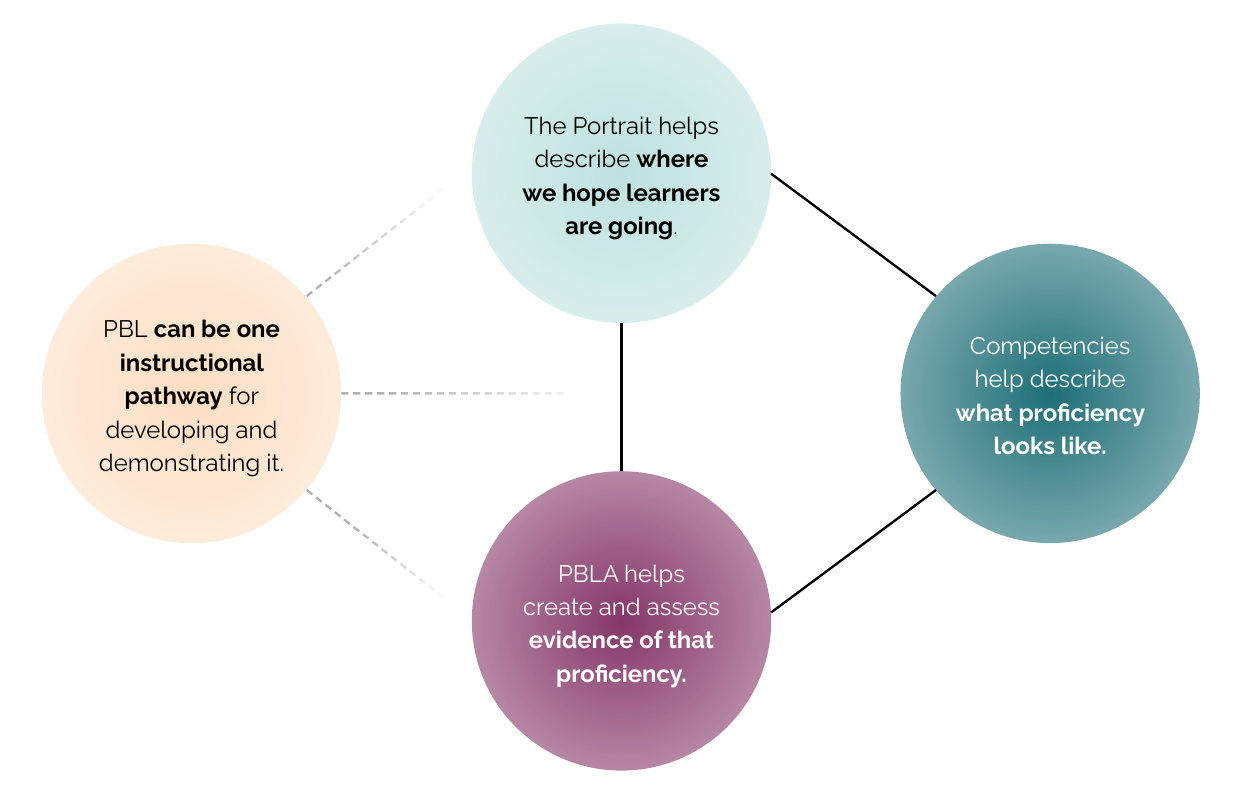
The important connection
That distinction matters because language shapes the sense people make of change.
If Portrait of a Graduate becomes a poster on the wall, it can remain disconnected from students’ daily experiences. If PBLA becomes synonymous with projects, educators may reasonably wonder whether academic content and rigor are being displaced. If competency-based education is understood only as a change to graduation requirements, we can miss the much larger conversation about what readiness actually means.
And that is the conversation underneath all of this.
For years, New York had a familiar answer to the question of readiness. Regents Exams were not the only evidence of student learning, but they became a powerful and widely understood measure within the system. They shaped curriculum, instructional priorities, accountability, and the professional identities of generations of educators.
Now the state is asking communities to consider a broader set of evidence.
That raises a question much harder than choosing a new assessment or adopting a new framework:
What gives us confidence that a young
person is ready for what comes next?
To answer that well, I think we have to go underneath the language of Portraits, competencies, diplomas, projects, and assessments.
We have to talk about learning.
3Learning, Achievement, and Readiness
Reconsidering what we mean by learning—and what counts as evidence that a young person is ready
What do we mean by learning?
Seymour Sarason was asking educators some version of that question more than two decades ago. In And What Do You Mean by Learning?, he pointed out something that still strikes me as remarkably true: education uses the language of learning constantly, yet we rarely stop to examine what we actually mean by it.
I have found that asking people to define learning is not particularly helpful.
So I usually ask a different question.
I ask educators to compare and contrast learning and achievement. At first, the exercise can feel almost too simple. People begin writing. The conversation starts. Someone puts an idea in one column and someone else challenges where it belongs. Before long, people start noticing something.
Learning and achievement are related.
But they are not the same thing.
Learning
An ongoing process through which people build knowledge, skill, understanding, judgment, and capacity. We learn through experience, feedback, dialogue, reflection, practice, failure, observation, and trying again. Learning is cognitive, social, and emotional. It happens in classrooms, but it certainly does not belong exclusively to students.
Achievement
Serves a different purpose. It helps us describe and communicate performance in relation to agreed upon expectations. Schools need ways to do that. Families deserve clear information about how students are doing. Communities need confidence that schools are preparing young people well. States have a responsibility to establish expectations and ensure students have access to meaningful educational opportunities.
Putting them in opposition creates a productive tension.
Achievement matters. The problem is not achievement.
The tension becomes interesting when we consider how much of our educational system has been designed around it.
We have become very good at defining achievement, establishing standards for it, measuring it, reporting it, comparing it, and attaching consequences to it. Over time, those measures have shaped not only our systems, but our identities.
Students learn whether they are “good at school.” Teachers become known by the courses they teach and the results their students produce. Principals carry the performance of their schools. Superintendents carry the performance of their districts.
In a system organized around externally defined measures of achievement, it can become easy to assume that learning is primarily what students do.
The adults, meanwhile, are expected to know.
We prepare. We lead. We teach. We implement. We evaluate. We make decisions.
Our own learning is often relegated to professional development days, conferences, courses, or something we fit around the work rather than understanding as part of the work itself. I don’t think learning and achievement are competing ideas. We need both. But putting them in opposition for a moment helps us see something we might otherwise miss.
Have we built systems that pay more
attention to demonstrating achievement
than to understanding how learning
actually happens?
And perhaps even more importantly for leaders:
What changes when we begin to think of
the adults, and the organization itself, as
learners too?
That question matters in New York right now. For decades, Regents Exams have played an important role in the state’s education system. They established a common measure, shaped curriculum and instructional priorities, influenced accountability, and became deeply connected to the professional identities of many educators.
As New York explores a broader set of graduation measures, educators are not simply being asked to use different assessments.
They are being asked to reconsider what counts as sufficient evidence that a young person is ready.
Those questions do not diminish achievement. They ask us to think more deeply about the relationship between learning, achievement, and readiness.
A rigorous system should still ask whether students know essential content. It should also ask whether they can apply that knowledge, explain and defend their thinking, revise based on feedback, transfer what they know into new contexts, and demonstrate their learning against clear and credible expectations.
New York’s proposed direction recognizes that students may demonstrate learning in multiple ways while maintaining statewide expectations. NYSED has described statewide competencies, common performance standards, rubrics, quality assurance, and accountability as essential features of the future system.
The state cannot and should not leave every question to local discretion. Districts cannot and should not wait for the state to define every learning experience.
There will need to be statewide coherence and local sensemaking.
But there is another capacity underneath both.
The adults responsible for creating this system will have to learn their way into it.
They will need opportunities to question assumptions, encounter new ideas, examine evidence, try things, learn from one another, change their minds, and develop increasingly shared understandings of learning, rigor, achievement, and readiness.
In other words, we cannot ask school systems to create richer conditions for student learning without also creating richer conditions for adult learning.
That realization became an important turning point in our work with districts.
4Four Patterns of Organizational Learning
What we began noticing as districts learned their way through the work
Once we stopped assuming that the adults already understood the destination, we began noticing something different in the work.
We started paying closer attention to how understanding developed.
Across districts, the contexts were different. Their size, geography, history, community expectations, leadership structures, and prior experiences varied considerably. Yet we kept encountering some of the same patterns.
Four, in particular, began shaping how I understood organizational learning.
These are not formal findings from the PLAN evaluation. They are field informed observations from our practice, strengthened by years of seeing similar dynamics in other systems. They are less a prescription for how change should happen than a description of what we noticed when we paid attention to how people and organizations were actually learning.
Pattern One – Clarity Does Not Always Come First
If you ask leaders what people need before a significant change begins, clarity is usually near the top of the list.
I understand why.
People need to know why the work matters. They need boundaries. They need to know what has been decided, what has not, and what is expected of them. No one benefits from avoidable confusion.
But I have become less convinced that leaders can create all of the clarity people need before the learning begins.
We learned this early in the PLAN Pilot.
Educators were often using Performance-Based Learning and Assessment and Project-Based Learning interchangeably. The acronyms looked similar. The ideas were related. But they were not the same thing.
At first, I thought we had a vocabulary problem.
So we defined the terms.
It did not solve the problem.
We tried again. I remember wanting to stop and get everyone to the same definition before we moved forward. Surely we needed shared language before we could do shared work.
But the clarity would not quite land.
Eventually, we let the learning continue.
Districts visited mentor schools. Teachers examined student work. Teams designed tasks. People tested ideas, asked questions, received feedback, and talked with colleagues who were wrestling with the same things.
And something interesting happened.
The language became more precise.
Not because we finally found the perfect definition.
Because people had more experience to attach to the words.
Kimberly Moritz, former New York superintendent and Senior Leadership Advisor for Modern Learners’ New York initiatives, helped me see another version of the same pattern.
The original PLAN design anticipated that districts entering different focus areas would need different places to begin. Districts working on Portrait of a Graduate appeared to be doing different work from districts exploring Performance-Based Learning and Assessment.
In practice, both groups kept arriving at the same foundational questions.
We thought their different destinations required different starting points.
Instead, they needed a shared opportunity to wrestle with the beliefs underneath the work.
That experience changed how I think about clarity.
People need enough clarity to begin. But deeper clarity is also produced through learning.
Experience gives language meaning. Dialogue exposes assumptions. Trying something creates new questions. Reflection helps people name what they understand differently now.
Clarity develops in layers.
Leaders create enough clarity for people to enter the work, then create the conditions in which deeper understanding can emerge.
Definitions can be given.
Understanding has to emerge.
“The challenge is not having every answer before we begin. The challenge is building organizations capable of learning while the answers emerge.”
Pattern Two – Change Is Human Before It Is Organizational
Strategic plans make change look remarkably orderly.
There is a vision. A set of goals. Strategies. Timelines. Measures. Perhaps a dashboard.
People do not experience change that way.
They experience it through everything they already carry with them.
A kindergarten teacher and a high school department chair can hear the same message and have completely different questions. A first-year principal and a veteran superintendent do not experience uncertainty in the same way. Neither does a parent, student, board member, or teacher.
People bring their histories, identities, responsibilities, expertise, hopes, fears, and commitments into the work.
That sounds obvious when I write it now.
I am not sure we have always designed change as though it were true.
When someone questions a new direction, it is easy to interpret the question as resistance. Our work has made me much more curious about what might sit underneath it.
A teacher asking about rigor may be protecting a commitment to academic quality.
A principal asking for clearer expectations may be thinking about the responsibility they carry for hundreds of students and staff.
A superintendent hesitant to make a promise may be protecting community trust.
People can believe deeply in a new aspiration and still hold commitments that make movement complicated.
Robert Evans’ work on the human side of school change and Robert Kegan and Lisa Lahey’s work on competing commitments gave us language for dynamics we were seeing in practice. People do not simply evaluate a new idea on its merits. They interpret it through what they already know, value, fear losing, and feel responsible for protecting.
During the PLAN work, Kim often returned to three leadership responsibilities that had entered our thinking through learning connected to High Tech High:
Permission.
Permission means creating space for people to question, learn, test ideas, and admit uncertainty before they are expected to perform certainty.
Protection.
Protection means protecting important learning from avoidable urgency, premature judgment, and the pressure to produce polished answers before understanding has had time to develop.
Policy Reduction.
Policy Reduction means examining the rules, routines, requirements, and habits that consume capacity without clearly advancing student learning or necessary accountability.
None of this means removing legitimate constraints. Schools operate within contracts, regulations, budgets, schedules, staffing realities, accountability systems, and community expectations.
The point is not to make change frictionless.
The point is to become more curious about the friction.
Those questions have become far more useful to me than asking whether someone is “on board.”
People do not need leaders who pretend uncertainty has disappeared.
They need leaders willing to name what is known, be honest about what is still emerging, and create conditions where people can continue learning without having to pretend they already understand.
Pattern Three – Collective Learning Does Not Happen by Accident
Education is filled with people who care deeply about learning.
That does not mean our organizations are designed for it.
For a long time, I assumed that if we created a meaningful enough professional learning experience, the learning would travel.
Teachers would return to their classrooms and use what they learned.
Principals would return from leadership sessions and lead similar conversations with their staff.
District teams would share what they were discovering with building teams, who would share it with teacher teams. Sometimes that happened.
Often it did not.
Not because people did not care.
Because we were asking learning to happen in the margins.
One conversation with Kim during the PLAN Pilot made that especially visible to me.
We were talking about teacher learning teams and the practical question of when teachers would meet.
Kim was thinking like a superintendent. She knew the schedules, staffing challenges, contracts, substitute shortages, and operational realities districts were navigating.
“Teachers will probably have to meet after school.”
I remember my immediate response.
“No.”
It was a small moment, but it opened a much bigger conversation.
If we believed adult learning was essential to changing student learning, why would we consistently place that learning outside the workday and hope people had enough time and energy left to do it well?
By the end of a school day, teachers may be picking up their own children, coaching, heading to another job, preparing for tomorrow, or simply recovering from a full day of teaching. The question was not really whether after-school meetings could ever work.
The question was what the organization was willing to protect. We were asking learning to compete with the work instead of recognizing that learning was the work.
Once I saw that, I stopped thinking primarily about how to improve professional development.
I started asking a different question:
What must leaders intentionally design if we
expect people to learn together?
Time matters.
Relationships matter.
Facilitation matters.
Access to examples matters.
Opportunities to examine student work matter.
Feedback matters.
Connections among teams matter.
Documentation matters.
The PLAN program itself recognizes many of these conditions through its emphasis on professional learning, mentorship, peer networks, Communities of Practice, coaching, and supportive policy environments. But naming those conditions and designing for them are different things.
A district can value collaboration and still give people no meaningful time to collaborate. It can value teacher agency while prescribing every step of professional learning.
It can tell principals to facilitate inquiry without ever allowing them to experience inquiry as learners themselves.
It can create multiple teams that are each learning something valuable while giving them no way to learn from one another.
When that happens, the problem is not necessarily resistance. Often, it is fragmentation.
Learning does not move through an organization simply because people care about the same goal. It has to be designed to move.
Pattern Four – Organizations Grow Into a Shared Vision
For a long time, I thought a shared vision was something an organization created and then aligned around.
Get the right people in the room.
Ask the right questions.
Find the right words.
Communicate the vision.
Then begin implementing it.
The work has complicated that idea for me. I have come to think there is an important difference between an aspiration and a shared vision.
An aspiration gives us direction.
A shared vision develops as people make meaning of that aspiration together.
New York’s Portrait of a Graduate offers a statewide aspiration for what young people should know and be able to do. Districts may also have local Portraits, strategic priorities, graduate competencies, mission statements, or other expressions of what they hope for their students. Those words matter. But people can agree with the same words and mean very different things by them.
The answers develop through experience.
That is why Kim often reminds leaders to return to their True North.
At first, returning to foundational conversations can feel like going backward.
Then people change.
New teachers join. Leaders transition. Students bring different experiences. Communities encounter new challenges. The organization knows things it did not know when the original conversation occurred.
The words may still be right.
But the people now reading those words are different, and the community’s understanding can be deeper.
John Clements and Mary Anne Moran’s long-term documentation of learning at Nipmuc Regional High School helped make this visible for me. Rather than preserving only a finished strategic plan, they documented years of questions, experiments, reflections, experiences, and shifts in understanding.
Looking across that history, you do not see an organization executing a fixed blueprint.
You see a community growing into its vision.
Alignment does not happen because everyone can repeat the same language.
It happens because people have enough shared experience that the language begins to carry shared meaning.
And because organizations are always changing, that meaning has to be renewed.
Returning to foundational questions is not evidence that the earlier work failed.
It is one of the ways an organization continues learning.
I no longer think organizations simply adopt a shared vision.
I think they grow into one.
What These Patterns Mean
When I step back and look across these four patterns, I do not think we discovered a better way to implement initiatives.
I think we rediscovered something more fundamental.
Organizations develop their capacity to learn through many of the same human processes that shape individual learning.
- Experience
- Reflection
- Dialogue
- Experimentation
- Feedback
Making sense of what happened together and deciding what comes next.
That realization changed the questions we were asking.
Instead of asking only, “How do we help districts implement this well?” we began asking:
Those questions eventually became the foundation for what we now call an Architecture for Sensemaking.
5Building An Architecture for Sensemaking
The structures and connections that help learning develop, move, and persist across an organization
Once we began seeing these patterns, another question followed.
If organizations have to learn their way through significant change, what conditions make that learning possible?
I had spent years thinking about professional learning as something we provided: workshops, coaching, resources, courses, meetings, and experiences designed to help people understand and implement something new.
Those things still matter.
But I began to see the limitation in thinking about them individually.
A powerful professional learning experience can change the thinking of the people in the room. It does not guarantee that their learning will reach anyone else.
A strong team can develop deep understanding. That does not mean another team will benefit from what they learn.
A thoughtful leader can make sense of complexity. That does not mean the organization will retain that understanding when the leader leaves.
The question was no longer simply how to create better professional learning.
The question became:
How does learning move through an organization?
That question led us toward what we now call an Architecture for Sensemaking.
I use the word architecture intentionally.
Architecture does not determine everything that happens inside a space. It creates conditions. It shapes how people move, where they encounter one another, what becomes visible, and what becomes possible.
Organizational learning needs an architecture too.
Not a formula.
Not a sequence every district follows in exactly the same way.
And not another initiative layered onto everything else.
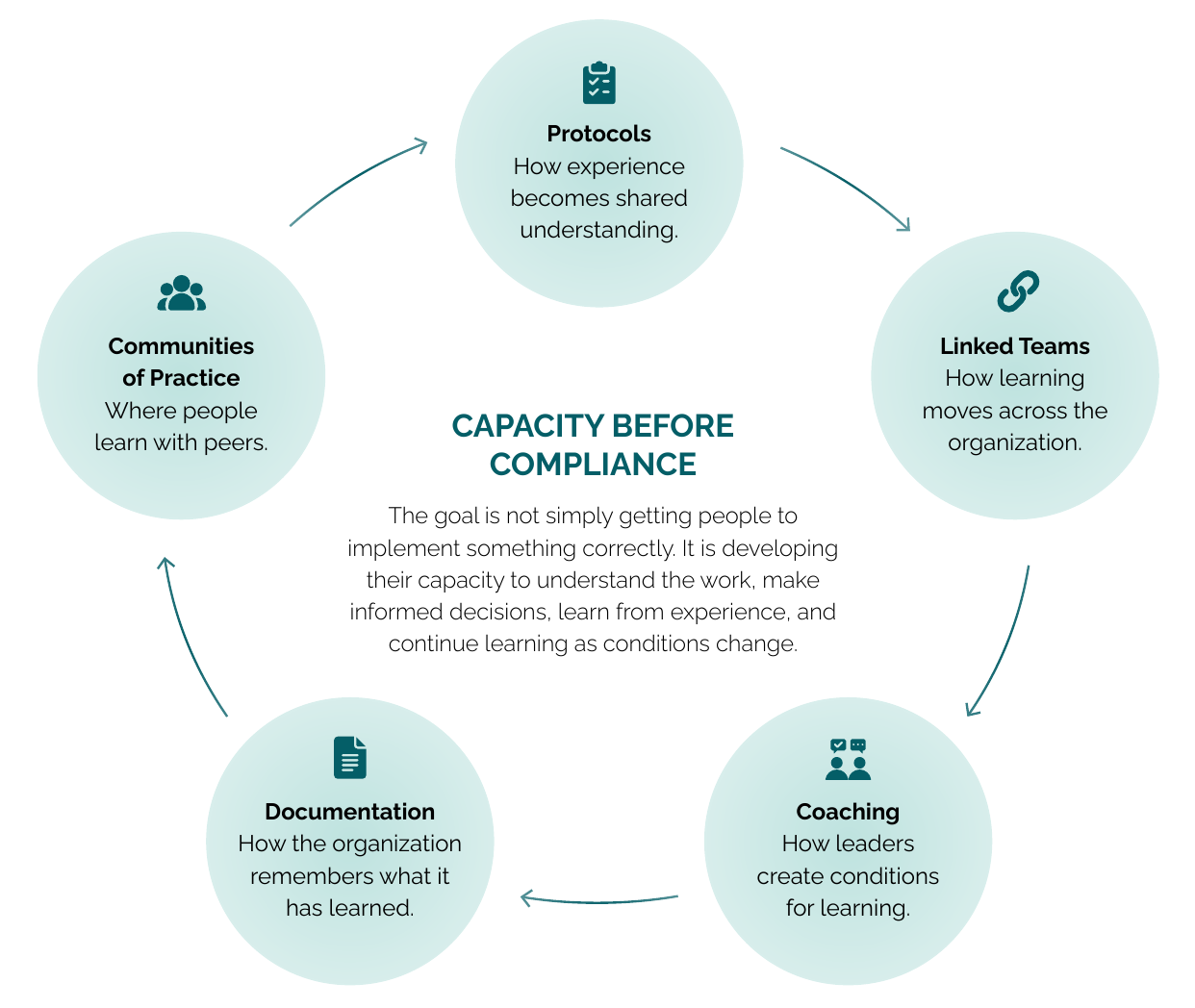
An Architecture for Sensemaking is the set of intentional structures, relationships, routines, and practices that help people make meaning together, move learning across a system, and preserve what the organization learns over time.
Its purpose is not to eliminate uncertainty.
Its purpose is to help an organization learn through it.
Capacity Before Compliance
There is a principle underneath the entire Architecture:
Capacity Before Compliance.
Capacity Before Compliance is not another structure in the Architecture. It is the principle that guides how every structure is designed and used.
Compliance asks:
Those questions sometimes matter. Schools operate within systems that have legitimate requirements and responsibilities.
But completion does not tell us whether an organization has developed the capacity to continue learning.
Capacity asks different questions.
When people are uncertain, the instinct is often to create more direction: another tool, another checklist, another set of expectations, another required deliverable.
Sometimes people do need more direction.
But sometimes what looks like a need for direction is actually a need for experience.
Or dialogue.
Or feedback.
Or time.
Or access to someone wrestling with the same problem.
Capacity Before Compliance asks us to diagnose the learning need before prescribing the response.
That principle changes how we think about every part of the Architecture.
People Experience Learning
If we want educators to create different learning experiences for students, they need opportunities to experience meaningful learning themselves.
This sounds simple.
It is surprisingly easy to violate.
We can tell teachers we value learner agency while designing professional learning in which they have none.
We can ask teachers to facilitate inquiry while giving them answers before they have had a chance to develop questions.
We can encourage students to revise work based on feedback while giving adults little opportunity to receive feedback, try again, and improve.
We can say collaboration matters while organizing adult learning around individual completion.
Over time, I have become convinced that the learning experiences we create for educators become part of the learning experiences educators are able to create for students.
If we want classrooms where learners ask questions, examine evidence, make choices, receive feedback, revise their thinking, and reflect on what they are learning, adults need opportunities to learn in those ways too.
That is one reason Communities of Practice matter within the Architecture.
A Community of Practice is more than a meeting of people who share a role or interest. It creates a sustained place for people engaged in related work to bring questions, examine experiences, test ideas, learn from one another, and develop shared language over time.
The value is not simply access to information.
It is access to other learners.
If the answer were already known, we could simply distribute it.
When people are learning their way toward something new, they need places to make meaning together.
Protocols support that work by giving conversations enough structure to remain focused without predetermining what people should conclude.
A protocol can help a team examine student work, unpack a dilemma, surface assumptions, give feedback, or reflect on an experience. The structure creates enough safety and predictability for people to think together.
The protocol is not the learning.
It creates conditions for learning to happen.
None of these structures produces learning simply because it exists.
The quality of the experience matters.
Learning Begins to Move
A meaningful learning experience is only the beginning.
If organizational learning depends entirely on who happened to be in the room, it remains fragile.
A district leadership team might develop a much deeper understanding of Portrait of a Graduate, only to discover that building leaders were still interpreting it differently.
A principal might have a breakthrough in a Community of Practice but struggle to recreate the conditions for that conversation with faculty.
A group of teachers might develop an important insight about student work that never traveled beyond their team.
The challenge was not simply creating more learning.
It was helping learning move.
That is the role of linked teams.
Districts already have teams. Often, they have many of them.
The question is whether those teams function as isolated groups or as part of a learning system.
Linked teams create intentional pathways among district leadership teams, building teams, teacher teams, and other groups so that learning can travel in more than one direction.
This is not simply a cascade model in which leaders learn something and then deliver it to everyone below them.
Learning also has to move back up.
When teams are linked, information can travel.
More importantly, learning can travel.
And as it moves, it changes.
A concept discussed at a district leadership table becomes more specific when teachers encounter it in classrooms. Questions from classrooms reshape leadership decisions. Student work challenges assumptions. Local context changes what a strategy looks like in practice.
That is not a failure of fidelity. That is sensemaking.
Coaching Keeps Leaders in the Learning
There is a particular challenge for leaders in all of this.
Everyone wants answers from them.
Boards ask.
Staff ask.
Families ask.
The state asks.
Leadership roles can create pressure to sound certain long before certainty exists.
That can make it difficult for leaders to remain learners.
Coaching creates a protected place for that learning.
At its best, coaching is not someone outside the system telling a leader what to do. It is a relationship that helps leaders slow down enough to examine what they are noticing, surface assumptions, consider alternatives, make decisions, and learn from what happens next.
A coach can ask the question that no one inside the organization has the position or distance to ask.
In that sense, coaching serves a different function from technical assistance.
Sometimes leaders need expertise.
Sometimes they need a thought partner.
Knowing the difference matters.
Coaching helps keep leaders inside the learning process rather than positioning them outside it as the people who are supposed to already know.
Learning Becomes Part of the Organization
Learning can move through an organization and still disappear.
People leave.
Leadership changes.
Teams reorganize.
Priorities shift.
The story of why a decision was made gets reduced to the decision itself.
A tool remains in a shared drive after everyone who understood its purpose has moved on.
This may be one of the least discussed challenges of organizational learning.
How does an organization remember?
Documentation matters because learning that lives only in individual people is vulnerable.
But documentation is not the same thing as keeping records.
A folder full of meeting minutes does not necessarily preserve learning.
The more important documentation captures the thinking behind the work.
This is one reason John Clements and Mary Anne Moran’s documentation of the long arc of learning at Nipmuc Regional High School has stayed with me. Looking across years of their work, you can see more than initiatives and outcomes. You can see questions changing. You can see thinking developing. You can see one experience informing another.
You can see the organization learning.
That kind of documentation creates organizational memory.
It allows new people to enter an ongoing story rather than assuming the story began when they arrived.
It allows teams to revisit earlier decisions with greater context.
It helps an organization notice patterns across time.
And it creates evidence not only of what the organization accomplished, but of how its capacity developed.
The Architecture Is the Connection
Communities of Practice. Protocols. Linked teams. Coaching. Documentation.
None of these ideas is particularly revolutionary on its own. Schools have used versions of all of them for years.
The Architecture is not the list.
The Architecture is the connection among them.
Wellsville offers one example of what those connections can look like in practice. What matters here is not that the district followed a prescribed sequence. It didn’t. What matters is how one learning experience created the conditions for another, and how learning that began with a small group of educators began moving through the organization.
How Learning Moved In Wellsville
- Teachers begin learning together.
- Protected time allows deeper sensemaking.
- Teachers try new practices, study what happens, and adjust.
- Experience changes understanding.
- Learning is documented and made visible.
- Teachers begin teaching and supporting other teachers.
- Participation and capacity grow.
- New questions emerge and another cycle of learning begins.
“We could have told teachers this until we were blue in the face. The shift happened when they experienced it themselves. Now we’re thinking about how to transfer this learning as we work with the elementary building.”
Caitlin Bowen
“The Google Classroom Caitlin set up was phenomenal. We could see where they were at, what they were learning, and their progress.”
Kathleen Agnello
A meaningful learning experience creates something worth making sense of. Protocols help people examine that experience together. Communities give them places to continue learning with others. Linked teams create pathways for learning to move through the organization. Coaching helps leaders remain learners while they make decisions inside uncertainty. Documentation allows the organization to retain what it learns. And what the organization learns shapes what happens next.
That is why I do not think of the Architecture as a linear implementation model.
Learning rarely happens in a straight line.
Different parts of an organization may need different things at different times. One team may be ready to design while another is still developing shared language. A leader may need coaching while teachers need access to examples. A district may discover through documentation that a question it thought it had answered needs to be reopened.
The milestones and forks in the road can be surprisingly predictable.
When people encounter them is not.
What they need emerges through doing the work.
Traditional implementation models can tempt us to believe that if we identify the right sequence in advance, we can move everyone through it together. But learning does not work that way. People bring different experiences to the work. Teams encounter different problems. Context matters. And sometimes an experience changes what people need next.
The Architecture gives leaders enough structure to respond to those emerging needs without pretending the entire path can be mapped in advance. It creates conditions for learning to move without trying to control exactly where learning must go.
Over time, that changes the organization’s relationship with change itself.
The organization becomes less dependent on any single initiative, consultant, leader, or set of instructions to tell it what to do next.
It develops the capacity to learn.
That is the outcome the Architecture is designed to support.
6From Framework to Practice
What an Architecture for Sensemaking asks leaders to do differently
If the goal is to build an organization capable of learning, what does that change about the work of leadership?
Maybe less than we think.
And maybe almost everything.
The Architecture for Sensemaking does not require districts to create an entirely new set of structures. Most school systems already have leadership teams, professional learning time, faculty meetings, instructional coaches, student work protocols, strategic plans, committees, and ways of documenting decisions.
The more interesting question is what those structures are designed to produce.
Are they primarily helping us coordinate work?
Or are they also helping us learn?
A leadership team can be a place where information is distributed and decisions are made.
It can also be a place where leaders surface assumptions, examine evidence, wrestle with uncertainty, and develop shared understanding.
A professional learning day can be used to communicate expectations.
It can also give educators an experience that changes how they understand learning.
A school visit can be a tour.
It can also disrupt assumptions and give people new language for something they could not previously see.
A meeting can produce minutes.
It can also produce organizational memory.
The structure itself does not tell us which one we are creating.
The way we use it does.
So rather than asking leaders to add an Architecture for Sensemaking to everything else they are doing, the more useful invitation is to examine the work already happening through a different lens.
“We were asking learning to compete with the work instead of recognizing that learning was the work.”
Protect Learning Before You Protect the Plan
Plans matter.
They create direction, communicate commitments, establish responsibilities, and help organizations coordinate complicated work.
But plans can also create an illusion of certainty.
Once something appears on a timeline, it can become surprisingly difficult to admit that our understanding has changed.
Organizational learning requires enough discipline to plan and enough humility to revise the plan when the learning tells us something new.
We have seen this repeatedly in the PLAN work.
Districts did not always need the support we anticipated at the moment we anticipated they would need it. Sometimes a team needed more time with foundational questions. Sometimes an experience accelerated understanding faster than expected. Sometimes trying something surfaced a question no one knew to ask beforehand.
That is not implementation failure.
That is learning.
This is one reason Plan, Do, Study, Act cycles have been useful in our work. The value is not the acronym or the template. The value is the discipline of treating action as an opportunity to learn.
That rhythm allows the plan to respond to the learning rather than requiring the learning to conform to the plan.
For leaders, that may mean looking at an existing strategic plan, implementation timeline, or professional learning calendar and asking:
Where have we intentionally left room for
what we do not know yet?
Create Experiences Before Expecting Understanding
One of the clearest lessons from the PLAN Pilot has been that explanation only takes us so far. We saw it when districts were trying to distinguish PBLA from Project-Based Learning. Definitions helped. Experience changed understanding.
School visits were particularly powerful because they gave educators something concrete to notice, question, and compare against their own assumptions.
The goal is not to copy what another school is doing. A good learning experience gives people something to think with.
The experience becomes useful because people make meaning from it together.
Formal PLAN case studies offer examples of what can become possible as districts begin translating broader aspirations into local practice. In Tupper Lake, interdisciplinary work connected academic content with community relevant learning. Port Chester used professional learning, site visits, mentoring, and coaching to strengthen educator capacity. Maryvale connected Portrait of a Graduate competencies to curriculum and community engaged learning. Waverly’s case illustrates the importance of leadership commitment and structures that support sustained collaboration.
Those examples do not tell another district what to do.
They give leaders something to learn from.
Examples become dangerous when we treat them as recipes.
They become powerful when we treat them as invitations to notice.
Protect Adult Learning as Part of the Work
If learning is part of the work, leaders need to see where the organization is making room for it and where it is unintentionally squeezing it out.
That requires looking beyond how much professional development a district provides.
These are design questions.
They are also leadership choices.
This is where Permission, Protection, and Policy Reduction become especially useful.
Sometimes creating more space for learning does not require adding time.
It requires deciding differently about the time we already have.
That may mean shortening an agenda, removing a standing report, questioning a meeting that has existed for years, protecting collaborative time from announcements that could have been communicated another way, or deciding that the learning happening among educators is important enough not to be the first thing displaced when something urgent appears.
Most school systems would say they value professional learning.
The more revealing question may be:
Is the organization designed as though
that is true?
“Collective learning does not happen by accident.”
Connect the Learners
One of the easiest mistakes to make in organizational change is to assume that because many people are learning, the organization is learning.
Those are not the same thing.
A superintendent may be learning.
Principals may be learning.
Teacher teams may be learning.
Students may be telling us something important through their experiences.
But if those insights remain within the people or teams where they originated, the organization can still behave as though none of that learning occurred.
Consider an existing district leadership structure.
What would happen if the question were not simply:
What information needs to move from this
team to the next?
but:
What learning needs to move?
A teacher team may not need another summary of the district’s Portrait of a Graduate work. They may need to hear about the question another teacher team encountered when trying to assess collaboration.
A district leadership team may not need another implementation update. They may need to see student work that complicates an assumption they have been making about rigor.
A superintendent may not need another status report from principals. They may need to know what teachers are repeatedly asking that leadership has not yet figured out how to answer.
This is where linked teams become more than an organizational chart.
They become pathways for learning.
Some of the school submitted PLAN spotlights suggest what this can look like in practice. Brookfield used collaborative curriculum design connected to its local Portrait of a Graduate. Irondequoit developed shared approaches to scoring student work. Wellsville connected interdisciplinary learning to community partners. P-TECH integrated student voice and peer feedback into its work. Binghamton used public exhibitions as part of how students demonstrated and discussed learning. These examples are school submitted descriptions rather than independent evaluation findings, so they should be understood as illustrations of practice rather than evidence of causal impact.
Still, they give us useful questions.
Those may be more useful questions than asking whether another district should replicate the practice itself.
“Definitions can be given. Understanding has to emerge.”
Make Learning Visible
Most organizations are very good at documenting activity.
We know when the meeting happened.
We know who attended.
We know whether the plan was submitted.
We know how many teachers completed the training.
We know whether the new rubric was created.
Those things tell us what happened.
They do not necessarily tell us what was learned.
If organizational capacity is the goal, we need evidence of learning too.
That evidence does not always fit neatly into a dashboard.
Sometimes it appears in the questions people ask.
A team that once asked, “Can you give us an example?” may later ask, “What evidence would tell us whether students are actually transferring this skill?”
That is movement.
A principal who once asked, “What are we supposed to do?” may begin asking, “What are teachers noticing, and what might we need to learn from that?”
That is movement.
A district that once needed an external facilitator to guide every conversation may begin facilitating those conversations itself.
That is movement.
A teacher team may revise a task after examining student work and discovering that the task did not elicit the thinking they intended to see.
That is movement.
None of those examples means the work is finished.
They tell us capacity is developing.
This is where I think we need to broaden what counts as evidence in organizational change.
We still need outcome measures. Student performance matters. Participation matters. Implementation matters. Accountability matters.
But if we are trying to understand whether an organization is becoming more capable of learning, we should also be looking for evidence such as:
That kind of evidence helps us see something a completion measure cannot.
It helps us see capacity developing.
Communicate What Is Known, What Is Emerging, and What We Are Learning
Leaders often feel pressure to communicate certainty.
I think there is another kind of trust available to us.
We can be precise about what is known.
Honest about what is still emerging.
And transparent about what we are learning.
Some things are established. The Portrait of a Graduate has been adopted. Current graduation requirements remain in effect. NYSED has articulated a proposed direction for future graduation measures and statewide competencies.
Other questions are still being worked out.
Local leaders do not need to fill that space with speculation.
Nor do they need to say nothing until every answer exists.
They can say:
Here is what the state has decided.
Here is what has not yet been decided.
Here is what our district is learning now so that we will be better prepared for what comes next.
That kind of communication does more than manage expectations.
It models learning.
It tells a community that uncertainty and incompetence are not the same thing.
It demonstrates that responsible leadership can include changing our understanding when new evidence becomes available.
And it gives people permission to learn without pretending they already know.
Start Where You Already Are
There is a temptation at this point to turn the Architecture into another implementation plan.
Please don’t.
The question is not:
How do we implement all five parts of the
Architecture?
The question is:
Where is learning already happening in our
organization, and what would help it move?
Perhaps your district already has strong teacher teams, but their learning rarely reaches district leadership.
Start there.
Perhaps principals meet regularly, but most of their time together is operational.
Start there.
Perhaps your teachers have had powerful professional learning experiences, but there is little protected time to try, reflect, and return to what they are learning.
Start there.
Perhaps teams are experimenting constantly, but no one is documenting what they are discovering.
Start there.
Perhaps you have built thoughtful structures, but people still look to a small number of leaders or consultants for the answers.
Start there.
The Architecture is not asking leaders to build everything at once.
It is asking them to notice the learning system they already have.
Then strengthen the connections.
Protect what matters.
Remove what gets in the way.
Pay attention to what emerges.
And keep learning.
7Implications for State and District Leaders
Building systems capable of continuing to learn
If organizations learn, then responsibility for change cannot sit in only one place.
The state has a role. District leaders have a role. Boards have a role. Teachers and students have roles. And those roles are connected.
Educational change can easily become a conversation about where responsibility belongs.
The state needs to provide more guidance.
Districts need to take more ownership.
Leaders need to communicate more clearly.
Teachers need more support.
Communities need more information.
All of those things may be true.
But I am increasingly interested in a different question:
What does each part of the system
need to do so that learning can happen
across the whole system?
That changes how I think about the relationship between coherence and local agency.
New York needs both.
For NYSED: Create Coherence Without Eliminating Learning
State leadership matters enormously in a transition of this scale.
Districts need clarity about what is required, what is proposed, what remains undecided, and when decisions are likely to be made. They need statewide expectations strong enough to protect rigor, equity, portability, and public trust.
They need guidance, exemplars, common language, performance standards, quality assurance processes, and opportunities to understand what emerging expectations mean in practice.
That is the coherence side of the work.
But there is another side.
If every important decision is made before districts have opportunities to learn from practice, the system loses access to something valuable: what implementation can teach us.
The PLAN Pilot creates an opportunity to learn before statewide expectations are fully settled. That is not simply a way to test whether districts can implement a predetermined model. It can be a way for the state to learn.
Those questions turn pilots into more than early implementation sites.
They turn them into part of the state’s learning infrastructure.
The challenge for NYSED is not to choose between statewide coherence and local learning.
It is to create a relationship between them.
The state establishes enough direction for districts to move responsibly. Districts learn through practice. That learning moves back into the system. State guidance becomes more precise. District practice becomes more sophisticated. New questions emerge. The cycle continues.
This requires listening structures as much as communication structures.
It also requires distinguishing between places where consistency is essential and places where variation is useful.
Some things should be common across New York. A student’s access to rigorous learning should not depend on their ZIP code.
Expectations for proficiency need credibility. Evidence of readiness needs to be trustworthy. Quality assurance matters.
But coherence does not require every classroom, school, or district to look the same.
A statewide system can establish what matters while allowing communities to learn how those expectations come to life in context.
That is not looseness.
It is a different kind of rigor.
For Superintendents: Lead the Learning, Not Just the Change
Superintendents occupy an unusual position in this work.
You are close enough to classrooms to understand the consequences of decisions and close enough to boards, communities, and the state to feel the pressure for answers.
People look to you for certainty.
But one of the most important things a superintendent can do right now may be to remain visibly engaged in learning.
That does not mean being indecisive.
It means being precise about the difference between a decision and an assumption.
Between what the state has established and what your district is still exploring.
Between what you know and what you are learning.
It means asking questions you do not already know the answer to.
It means allowing evidence from teachers and students to change your thinking.
It means protecting time for people to make sense of the work rather than interpreting every request for time as a delay in implementation.
And it means paying attention to whether the organization is becoming increasingly capable of continuing the work without you at the center of every decision.
That last one may be the hardest.
Leadership can accidentally create dependence.
When a superintendent is deeply committed, highly knowledgeable, and skilled at moving work forward, it can be tempting to solve problems quickly.
Sometimes that is exactly what leadership requires.
But if every difficult question eventually travels back to the superintendent, the organization may be moving without actually building much capacity.
A different question is:
Who else needs to learn how to wrestle
with this?
That question distributes more than responsibility. It distributes learning.
For Boards: Govern the Direction Without Demanding False Certainty
Boards have an important role in creating the conditions for this work.
They establish policy. They steward public resources. They represent community expectations. They hold superintendents accountable. And they ask questions that deserve thoughtful answers.
In periods of significant change, boards can also feel pressure to demand certainty that does not yet exist.
Those are reasonable questions.
The challenge is distinguishing between uncertainty caused by poor planning and uncertainty inherent in learning.
Boards do not need to lower expectations for leadership.
They may need to broaden what evidence of strong leadership looks like.
Those questions allow boards to govern responsibly without forcing leaders to pretend the future is more certain than it is. A board can hold a district accountable for learning.
For Districts Already Doing the Work: Make Your Learning Available to Others
The districts participating in PLAN and Inspired by Design occupy an important position in New York’s transition.
You are not simply early adopters. You are generating experience the larger system can learn from.
That creates an opportunity and, I think, a responsibility.
Document what you are learning.
Not only the polished examples.
Document the questions. The false starts. The task that did not produce the student thinking you expected. The rubric that changed after teachers tried to use it. The community conversation that revealed an assumption. The school visit that shifted someone’s understanding. The question your team cannot answer yet.
Those may be some of the most useful things you contribute.
Education has a tendency to share finished products. We publish the final Portrait. The polished performance task. The completed rubric.
The strategic plan. The success story.
Those artifacts can be useful.
But they hide the learning that produced them.
If other districts are going to learn from the work, they need more than the finished artifact.
They need access to the thinking.
That is how one district’s experience becomes capacity for the larger system.
For All of Us: Resist the Urge to Finish Too Quickly
There is a tension running through all of these roles.
Systems need decisions. People need direction. Students are in classrooms today.
We cannot remain indefinitely in exploration.
At the same time, moving quickly toward an answer can sometimes prevent us from learning enough to arrive at a better one.
The work is not to celebrate ambiguity.
It is to develop the capacity to move responsibly within it.
That requires judgment.
I don’t think there is a framework that can answer those questions for leaders in advance.
And maybe that is the point.
The capacity we are trying to build is not the ability to follow the right implementation model.
It is the ability to notice, learn, make sense of what is happening, and respond with increasing wisdom.
If New York can build that capacity at the classroom, school, district, and state levels, the value will extend far beyond this particular transition. Portrait of a Graduate will not be the last significant change schools encounter.
Performance-Based Learning and Assessment will not be the last practice educators are asked to understand. And the graduation system New York ultimately builds will not be the final question the field has to answer.
There will always be a next question.
Not simply because another initiative, mandate, or challenge will arrive.
Because that is what learning does.
Learning changes what we can see. What we notice creates curiosity. Curiosity generates new questions. And those questions take us somewhere we could not have anticipated before we began.
The goal, then, is not to build a system capable of getting through this transition so it can finally arrive at certainty.
It is to build a system that becomes increasingly capable of learning.
A system that knows how to follow the next question.
What We Leave Behind
For much of my career, I thought leading change meant helping people get from where they were to somewhere else.
I think about that differently now.
I am less interested in whether a leader can move an organization through a particular change. I am more interested in what the organization becomes capable of because of the way that leader chose to lead it.
A superintendent can leave behind a strategic plan, a new program, a redesigned schedule, a Portrait of a Graduate, a collection of performance tasks, or a new assessment system. All of those things may matter.
But perhaps the more enduring legacy is an organization that has become better at learning.
Those questions have changed what I think leadership legacy looks like.
Years ago, I began using a phrase that still captures what I believe about this work:
I’m not asking you to change. I’m asking you to learn.
I understand that phrase differently now.
Learning will change us.
It changes what we notice, the questions we ask, some of what we believe, and what we are willing to try. If we are paying attention, it eventually changes the systems we create together.
But change is not the starting point.
Learning is.
Perhaps that is the leadership legacy worth pursuing: not an organization that successfully completed one more change, but one that became more capable of learning because of the way we led it.
The next question will come.
What matters is whether we have built an organization capable of following it.
Sources & Resources
The ideas in this paper have been shaped by research, policy guidance, published case studies, field documentation, and years of learning alongside educators and school systems. The following sources provide additional context and opportunities to explore the ideas and examples referenced throughout the paper.
New York State Education Department & PLAN
- New York State Education Department. “New York State Portrait of a Graduate.” July 31, 2025.
- New York State Education Department. “Board of Regents and State Education Department Announce Plan to Move Toward First-in-the-Nation Competency-Based Diploma.” June 15, 2026.
- New York State Education Department. “Frequently Asked Questions Related to the New York State Graduation Measures Initiative.”
- New York State Education Department. “NY Inspires.”
- New York State Education Department. “Performance-Based Learning and Assessment Networks (PLAN) Pilot.”
- New York State Education Department. “PLAN Pilot Case Studies.” Case studies developed by PLAN research partners at the University at Albany, SUNY, and Russell Sage College.
- New York State Education Department. “Pilot School Spotlight.” School-submitted tools, presentations, progress updates, examples, and reflections from PLAN Pilot schools.
Books & Frameworks That Informed This Work
- Evans, Robert. The Human Side of School Change: Reform, Resistance, and the Real-Life Problems of Innovation. Jossey-Bass, 1996.
- Kegan, Robert, and Lisa Laskow Lahey. Immunity to Change: How to Overcome It and Unlock the Potential in Yourself and Your Organization. Harvard Business Press, 2009.
- Sarason, Seymour B. And What Do You Mean by Learning? Heinemann, 2004.
- National Implementation Research Network. “Active Implementation Frameworks.” Resources related to implementation teams, implementation drivers, coaching, leadership, and enabling contexts.
- The W. Edwards Deming Institute. “PDSA Cycle.” Resources on the Plan-Do-Study-Act cycle and learning through continual improvement.
- Jarche, Harold. “Seek, Sense, Share.” Framework for seeking information, making sense of it, and sharing knowledge through networks.
Field Documentation & Additional Resources
- Clements, John, and Mary Anne Moran. “Nipmuc Roadmap 2017–2019.” Long-term documentation of Nipmuc Regional High School’s learning journey.
- Modern Learners. PLAN Pilot Interviews and Working Sessions. Interviews, conversations, and working sessions with leaders and educators participating in New York’s PLAN Pilot, 2023–2026.
- Modern Learners. Wellsville Secondary School Interviews. Interviews with Wellsville leaders conducted as part of PLAN Pilot documentation, 2026.
- Modern Learners. Binghamton City School District Interview. Interview with PLAN project leadership conducted as part of PLAN Pilot documentation, 2026.
Acknowledgements
If this paper has one central message, it is that understanding doesn’t arrive fully formed.
It emerges through learning together.
That has certainly been true for me.
The ideas in these pages were not developed alone. They are the product of conversations, questions, disagreements, observations, and shared experiences with educators who have generously invited me into their schools and their thinking for more than two decades. Every district, every leadership team, every classroom visit, and every difficult conversation has shaped the way I understand learning today.
Several people have left an especially lasting imprint on this work.
The New York State Education Department’s PLAN Pilot team—Allison Armour-Garb, Nicole Lennon, and Jie Gao—created far more than a statewide initiative. Throughout the project, they met with us regularly to ask questions, share what they were noticing, work through challenges, and make sense of what was emerging across the pilot. Their willingness to remain in the learning alongside districts and partners helped create the conditions for many of the insights reflected in this paper.
Kimberly Moritz has been far more than a colleague. She has been a thinking partner whose experience as a superintendent continually challenged and refined my own assumptions. Throughout the PLAN Pilot, countless conversations with Kim helped turn ideas into practice and practice into deeper understanding. Many of the insights in these pages emerged because we were willing to wrestle with the work together.
John Clements and Mary Anne Moran remind me what organizational learning looks like when a community commits to making its thinking visible. Their willingness to document not only what changed, but how their understanding evolved over time, has influenced both my thinking and this manuscript in profound ways. Their connection to this work reaches back to Change School in 2017, making it especially meaningful to see how their learning has continued to evolve over time.
Jayne Bischoff helped shape the foundation long before many of these ideas had names. Our work together supporting Universal Design for Learning across Wisconsin gave me the opportunity to see organizational learning unfold across 31 districts and 12 CESAs (Cooperative Education Service Agency). More importantly, Jayne continually pushed our thinking beyond where it began. That shared learning became part of what prepared Modern Learners to serve New York’s PLAN Pilot years later.
Kristin Galle has quietly shaped nearly every idea I’ve ever shared. Long before artificial intelligence could organize a brainstorm, Kristin was translating whiteboards, sticky notes, and half-finished thoughts into something coherent. She has an extraordinary ability to see the structure inside emerging ideas and create the accountability that helps them move from conversations to manuscripts. This paper exists because she has spent years helping ideas find their way out of my head and onto paper.
My deepest professional gratitude belongs to Will Richardson and Bruce Dixon.
Long before Modern Learners became an organization, they invited me into a different way of thinking about schools, leadership, and learning. They challenged assumptions I didn’t yet know I held, trusted me with opportunities I hadn’t imagined for myself, and modeled what it looks like to remain a learner even after decades of leading. Nearly every page of this manuscript carries something I first learned alongside them.
Finally, I want to thank the hundreds of educators who have trusted us with their questions.
The 31 Wisconsin districts that learned alongside us through our statewide Universal Design for Learning work.
The 17 New York districts that courageously participated in the PLAN Pilot.
The additional 19 districts we continue to learn alongside through our continued work in New York.
Our partners in Montana and the many mentor schools whose stories continue to inspire others.
Every superintendent who admitted they didn’t yet have the answers.
Every principal who opened classroom doors.
Every teacher who was willing to try something new.
Every student whose learning challenged us to rethink our own.
You have been my greatest teachers.
I hope this paper honors what we have learned together.
About the Author
Melissa Emler is the Chief Learning Officer at Modern Learners, where she works alongside school and system leaders navigating significant changes in teaching, learning, and assessment.
Her perspective has been shaped by more than two decades working across education systems—as a classroom teacher, special education teacher and director, principal, district and statewide systems partner, and now Chief Learning Officer. Those experiences have allowed her to encounter educational change from multiple places within a system and to pay close attention to what helps people learn their way through it.
Her systems-level work has included supporting 31 Wisconsin school districts through a statewide Universal Design for Learning initiative; partnering with the New York State Education Department and 17 districts through the PLAN Pilot and 20 additional districts through Inspired by Design; supporting statewide teacher recruitment and retention work in Montana; and developing an implementation fidelity rubric, grounded in implementation science, with Ohio’s statewide UDL team.
Across those experiences, Melissa’s work has increasingly centered on the human side of change: creating the conditions for people to learn together, making room for understanding to emerge through experience, and helping leaders respond to what people need as the work unfolds.
She believes meaningful change does not begin by asking people to follow a perfectly mapped path. It begins by creating the conditions for them to learn.
That belief is captured in a phrase that has guided her work for years:
“I’m not asking you to change.
I’m asking you to learn.”
What is your organization learning right now?
Modern Learners works alongside school and system leaders to create the conditions for people to learn together, make sense of complexity, and build the capacity to lead what comes next.
Continue the conversation.
Modern Learner Media, LLC
101 N. Main St.
Potosi, WI 53820
(716) 246-4552
Okay, So What Do We Do?
You don’t have to work through this alone.
Join six live discussions with Melissa Emler and other school leaders, plus an ongoing online conversation where you can ask questions, share what you’re trying, and learn from one another on your own time.
Come to one session or all six. Keep talking between sessions and beyond the series.
October 21 to November 25, 2026 · Wednesdays at 10 a.m. Eastern
Join the conversation